
Cycling to Drenthe’s hunebedden and the Veenhuizen forced labor colony
Drenthe is quite empty compared to the rest of the Netherlands: no major cities, the lowest population in the country, and not a hotspot for career hunters. For an adventure, though, you couldn’t ask for a better place. We actually started just outside of it, in Groningen — the north’s only real urban hub, which everyone around here calls “The City” — and then crossed over.

We were heading to the village of Norg to see one of Drenthe’s prehistoric monuments, but first stumbled upon a place that looked almost alien amid all the greenery. This was UGS Norg, one of the largest seasonal gas storage facilities in Western Europe, but you cannot grasp its size from the surface. Instead of using metal tanks, it utilizes a natural gas field deep underground. We first imagined it as a colossal cavern, but in reality, the gas is held inside porous sandstone, acting as a gigantic sponge.

After passing the UGS, we dove into the quiet canopy of the Norgerholt Forest. It’s a remarkably scenic area, with a few still pools of water where trunks rise straight out of their mirror surface.

We could literally feel the age of the Norgerholt as we rode through. It’s one of the oldest protected woodlands in the country, possibly dating back to the 9th century.

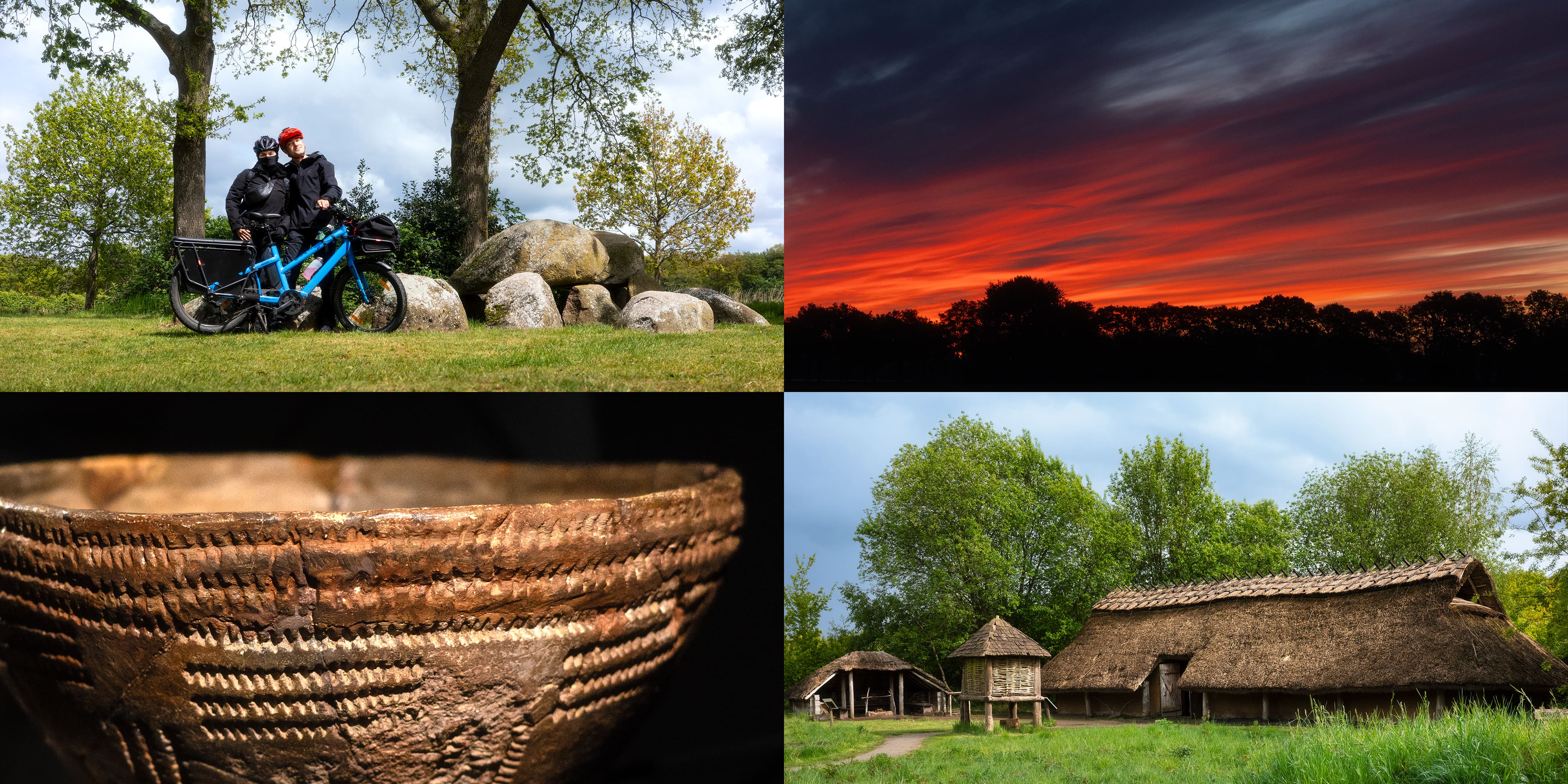
And then we reached our first dolmen — or “hunebed,” as they’re called in Dutch — a Stone Age monument built for collective burials. Today, we only see the bare “skeletons” of these structures. Originally, they were completely covered with earth to look like grassy hills.

The dolmen D2 sits east of the village of Westervelde in a peaceful spot right next to farmhouses. It’s fairly modest — about eight by three meters — and only two of its four original capstones still rest on the roof. Before these tombs were legally protected, locals would drill holes into the boulders, pack them with gunpowder, and blast them apart for road pavement or construction. The fractured chunk lying inside the chamber is a permanent scar from those demolition attempts.

At that point, we had to choose: keep hunting for other dolmens, or head off-route to explore Drenthe’s prison history. Knowing we had two full days left to find more stones, we decided to check out the National Prison Museum in Veenhuizen. This horrifying place began in the 1800s as a forced-labor colony for orphans, beggars, and the poor, eventually evolving into a high-security state prison.

The village of Veenhuizen itself was essentially an entire colony back then, featuring dozens of buildings to house the prisoners and the guards who watched them. The museum is set up inside the oldest standing structure, called the Second Institution (or “Tweede Gesticht” in Dutch). It’s built in a rigid square, sealing off a courtyard inside.

The Second Institution was the most notorious spot. It isolated orphans and beggars from the rest of society and forced them into hard agricultural labor to “cure” their poverty. Thousands of children were sent to this square block just for the crime of being poor and alone.

The museum tracks several centuries of crime and punishment, so we had to look closely to separate the artifacts tied to the colony’s own history from those that simply showed the general cruelty of the past. For example, we came across a sinister 17th-century execution cross. Executioners used it to shatter a criminal’s bones with a heavy iron bar before hoisting the broken body onto a high wheel to die. This practice had been outlawed before the Veenhuizen colony was established.

But the next exhibit — a row of hammocks strung up against the windows — had a direct connection to the colony. In the 1800s, hundreds of orphans slept packed together in these open halls. The windows offered no escape, only a direct view into the courtyard where guards carried out brutal public punishments.

Next, we came across a row of bizarre iron cages called “slaapkooien.” When the state took over Veenhuizen and turned it into a prison, the open sleeping halls became a real security headache for the guards, so they constructed these cages. Every evening, they would lock each inmate inside a cage equipped with nothing but a hammock and a toilet pot.

We left the museum in a heavy mood, and as we rode through Veenhuizen, the dark history followed us onto the streets. I noticed bold inscriptions carved onto the facades of the residential houses; for instance, one read “Werk en Bid” (“Work and Pray”).

Colony directors placed these slogans on the staff houses lining the main roads. As inmates marched from their dormitories to the surrounding peat bogs and heather fields to farm the land, the very architecture demanded obedience.

Then we rode to the Esmeer Lake. The landscape here was stunning; what used to be farmland turned into juicy meadows.

Locals know it as a prime spot for crane-watching. We didn’t bring heavy-duty binoculars, but after Veenhuizen, just standing in an open field with nothing fencing us in felt like plenty.

I headed up the viewing tower to check out the panoramic view from above. Meanwhile, Oksanka remembered the thermos in our bag, so we took a break for some tea and sweets.

I looked at my watch and realized that despite the warm sunlight, it was getting late. We could have explored several more spots, but decided to go straight to our B&B near Assen and get some proper rest before another day of cycling.

When we finally arrived, it turned out to be an adorable little “esdorp,” or traditional farming village, called Loon. Several of these historic settlements sit within the Drentsche Aa National Park. The old longhouses here have thatched gabled roofs that stretch almost to the ground.

We really wanted to drop our things and go explore the village, but after a hefty dinner, we just gave up and went straight to bed. Before dozing off, I almost unconsciously set my alarm for 5 a.m., hoping I’d get enough sleep to wake up that early.
Dolmen hunting at sunrise: the hunebedden of the Drentsche Aa National Park
Did I wake up before sunrise? Well, you already know. Oksanka just mumbled something from under the covers, so I left her in bed and slipped out to satisfy my photo craving before breakfast.

I rode straight to dolmen D15, which was just minutes away. It hid in deep tree shadows while the sunrise was cutting in from behind. It felt way more intact than the one from yesterday. When legendary Dutch archaeologist and “Father of the Dolmens” Albert van Giffen got here in 1920, the tomb was a total mess; its capstones had slipped off and were just sitting on the floor. He managed to hoist the whole structure back together, lifting those giant boulders back onto their supports.

Meanwhile, the sky was turning a striped pink-violet, painted with high-altitude cirrus clouds that looked like feathers or horse tails.

Nature started waking up with the sun. I met a sheep who stared at me, probably trying to process what the heck I was doing out there. It had a very intelligent face and an unusually long tail.

Then I spotted a real “stork hotel” among the trees — a row of tall poles topped with massive nests. One stork was busy feeding its chicks up there. Judging by the sheer height of the nest, the couple must have been returning to this exact spot for years, adding fresh layers every spring.

A low morning mist was rolling in, turning the ground white in the distance. The grass perfectly reflected in the still creeks, and the air was filled with nothing but birdsong.

The scenery around me shifted from open fields to meadows and then to the shrubby dunes.

Next up was dolmen D10, located out in the Gasterse Duinen. This nature reserve is a gorgeous stretch of rolling heathland covered in grayish shrubs and solitary trees.

The dolmen itself was tiny and clearly missing many pieces. Van Giffen excavated the site in 1921 and uncovered a whole treasure trove of clay pottery. Most of these artifacts come from the Funnelbeaker culture that stretched across modern Denmark, the Netherlands, northern Germany, and Poland. This ancient society emerged in 4100 BCE — more than six thousand years ago!

I looked up and started worrying a bit about the weather. The day had barely started, but the clouds were already promising rain. The rain was still holding off, though, so I pedaled on confidently.

I left the fields and dunes behind, entering a thick woodland on my way to the massive dolmen D11, which sat in the middle of a wide clearing at the intersection of forest paths.

D11 was clearly missing a capstone, but it looked pretty intact otherwise. Later, I learned that it originally stood in open heathland, and that the thick forest around it was only planted in the 1920s for timber production.

Not far from the dolmen were three burial mounds. The sun shone directly on them, making them an emerald green. Though often labeled as Iron Age (around 2,500 years ago), they are actually older — reused by one generation after another, spanning several prehistoric cultures.

Unlike dolmens, these mounds were just small hills of earth and turf, built without stones. Depending on the era, they were used for either full-body burials or cremations.

Then, the landscape changed again. As I headed toward the other dolmens, I rode into a warm, steaming field.

It was past 7 a.m., and I started seeing a few locals on their bikes heading out to start their day. We traded quick “Goedemorgen!” greetings.

Since I didn’t know the area well, I accidentally ended up in a few hiking-only zones, so I hopped off and walked the bike. And honestly, it was a good thing I did! While the wild horses ignored me, I ran into a family of Highland cows with five calves, and I was glad to be on foot. The cows gave me a menacing look, so I just passed by at a steady pace, giving them no reason to start any trouble.

But it wasn’t all tense encounters. I met adorable ponies lined up with their foals, almost like they were setting up for a photoshoot. The foals tried to hide behind their parents, but everyone was relaxed and didn’t seem to mind a curious two-legged intruder in a red helmet.

After that, I arrived at a pair of dolmens — D17 and D18 — marking the first time I’d seen two together instead of a solitary monument. They stood in a beautiful rural area near Rolde, neighboring a village cemetery and the 14th-century church.

D18 looked perfectly intact, with all seven of its capstones neatly in place, while its neighbor, D17, was a bit of a mess. D17 originally featured eight capstones, but most of them have slipped off their pillars or broken apart.

Believe it or not, these two played a real part in why the Netherlands protects prehistoric heritage today. In 1847, the local council put them up for sale to private buyers, and they were almost smashed up for building materials. It caused a national scandal until the government stepped in to buy them back, setting a precedent the state would lean on again later.

Since these prehistoric sites are next to old villages, people have been documenting them for centuries. The very first recorded name for a Dutch dolmen appears in a text from 1505 as “Des Duvels Kolse” (“The Devil’s Cunt”). While folklore long associated this nickname with the twin dolmens behind the Rolde church, modern research shows it belonged to D10, which I had seen an hour ago in the Gasterse Duinen.

Did I feel I had seen enough dolmens? Of course, not. And the next one was just around the corner in the freshly plowed fields.

D16 looked flawless, with all capstones and the side entrance, and stretching over fifteen meters. But here’s a catch. When Albert van Giffen first surveyed it in 1925, he literally described it as being in a “sad state,” as no one could guess the original layout. He went ahead and restored it anyway, so what we’re looking at now is basically one guy’s best guess.

The sun stood high in the sky. Oksanka had woken up and was calling to check on me. But I was almost there, and we managed to walk downstairs right on time for breakfast.
The Drents Museum: bog bodies, the Girl of Yde, and the world’s oldest boat
Once we packed up our things, we rode toward the provincial capital, Assen, to visit the Drents Museum and dive even deeper into the prehistoric lore. The museum is famous for its bog bodies and ancient graves, for example, the tree-trunk burial of a Bronze Age woman cradling her child.

We looked at old arrowheads, spears, metal ornaments, and stone tools. Some of those stone pieces weren’t just a few thousand years old, but date back tens of thousands of years!

In the painting gallery, I recognized the Loon dolmen, D15, which I’d stood right next to just a few hours earlier, before sunrise! Johan Dijkstra had captured it from a different angle, though, leaving out the trees in the background.

Walking through the maze of exhibition rooms, we came up to one of Drenthe’s biggest treasures, a dugout canoe that’s widely considered the oldest boat in the world. Carbon dating places it in the early Mesolithic period, around 8000 BCE, making it roughly ten thousand years old. That means it predates Stonehenge, the Egyptian pyramids, and even Drenthe’s dolmens!

The boat was carved out of a single pine log. Frankly, looking at the heavily damaged timber, it was tough to see how it ever functioned as a boat, but a nearby interactive model really brought it to life.

The second of the two museum’s biggest highlights was the Girl of Yde, an incredibly preserved bog body of a 16-year-old girl who lived during the Iron Age, around the 1st century AD. She was found with a wool rope wrapped three times around her neck and half of her hair shaved off, hinting at a ritual sacrifice or execution.

The acidic waters of the peat bog tanned the girl’s skin and turned her blonde hair reddish-gold. Seeing her look so lifelike was unsettling, and we felt uneasy staying in the room.

Next, we found ourselves staring at these huge displays of ancient pottery. It was a mix of preserved pots, glued-together ones, and literal piles of shards, looking like a hopeless jigsaw puzzle.

Most of the drinking cups, buckets, and bowls dated back to between 4000 and 2000 BCE, the era of the dolmens. I recalled a theory that these elaborate patterns originally started just to show who owned which dish, before eventually evolving into a kind of visual identity for different families or tribes.

We thought the Girl of Yde was as eerie as it would get, but then we came across the flattened, leathery remains of the Zweeloo Woman. She might have been sacrificed simply for being different from her Iron Age neighbors; modern scans revealed she had a rare genetic disorder that left her with unusually short, bowed limbs. Her bones carry over twenty knife marks, leaving archaeologists to argue over whether she met a violent end or was just laid to rest with unusual funeral customs.

The last thing we expected to walk away with was a cute Highland cow plush from the museum shop. Oksanka was cuddling it the entire time at the café in Assen, while I was having vivid flashbacks to my morning encounter with actual cows ready to charge to protect their calves.
Cycling to the Hunebedcentrum in Borger through the rainy forest

Recharged after a quick coffee, we continued exploring Drenthe. The clouds lowered, looking even more menacing, but the sun still managed to pour its light through sporadic openings.

We soon arrived at dolmen D14 in Eext. The bright, sunny boulders looked awesome, contrasting against the deep shade of the trees and that dark-blue sky. It’s an 18-meter-long structure, one of the country’s biggest. It has eighteen supporting stones and six capstones left from the original eight or nine, plus the remnants of the entrance. When Albert van Giffen excavated here in 1927, he unearthed 20,000 shards of ancient pottery from the chamber!

Right as we rolled away from D14, it started raining. Just a soft drizzle, though — nothing that could ruin the ride. We thought it was time for a quick break from the dolmens, so we headed to check out some gorgeous forest lakes.

The road soon became a dirt track through the woods, and I had to watch my lines to weave around deep puddles.

We were looking for a specific cluster of lakes:
- Hemelrijk — a natural Ice Age fen. It’s blocked off to give it a chance to heal from decades of tourist damage, so we didn’t get close.
- ‘t Nije Hemelriek — a recreational lake created in the 1960s to give swimming vacationers an alternative to the fragile Ice Age pond.
- Gasselterveld — a large lake with sandy beaches and turquoise water. It used to be an industrial sand quarry and is up to 50 meters deep.

As we walked around ‘t Nije Hemelriek, we could see the rain clouds creeping up on us from the west.

Just before the downpour began, we ducked inside a cafe for shelter. I ordered a local craft beer, only to find a surprising connection to the start of our trip: it was from Maallust, a brewery housed in the former forced-labor mill of the Veenhuizen prison colony!

It wasn’t that we didn’t appreciate a lovely lunch, but we were worried about arriving late at the Hunebedcentrum — the dolmen museum in the village of Borger. So we picked up the pace and eventually got an hour and a half to explore the place.

Inside, they built a fantastic full-scale replica of a dolmen interior. We stepped into that dark, enclosed space and tried to feel how our ancestors used these eerie chambers for cremations and burial rituals.

Prehistoric houses in the Hunebedcentrum and the largest dolmen of the Netherlands
After checking out the exhibition, we headed out to the park with reconstructed prehistoric dwellings — something Oksanka had been looking forward to for a long time. And the drizzle gave us a perfect chance to test how well these houses sheltered people from the elements.
The first one we came across was a reindeer hunters’ hut, essentially just leather sheets draped over a cone of sticks. It was designed to be lean so you could easily pack it up and move on while chasing the herd. Such tents were popular at the end of the last Ice Age, around 13,000 BCE, when this entire region was a tundra.

Right nearby stood a Mesolithic hut that honestly looked like a large upside-down nest. This design dates back to between 8000 and 5300 BCE. Since the planet was finally warming up, forests began to grow, and people could stay in one area for much longer. They built these huts by weaving hazel branches together and packing them tightly with reeds and turf.

Then we came around a bend and saw a real upgrade in prehistoric real estate — a Neolithic longhouse. This wasn’t a mobile shelter, but a permanent communal home built by the Funnelbeaker culture — the very same people behind dolmens.

Such longhouses dotted the landscape between 3400 and 2850 BCE, constructed with heavy oak posts, thick clay-plastered walls, and tall thatched roofs covered in a plush moss carpet. What blew my mind was that the layout of the farmhouses you see in Dutch villages today almost hasn’t changed for over five thousand years!

The Iron Age farmhouse was less of a surprise since it kept the same layout as the Late Stone Age version, just with cleaner craftsmanship and a sturdier frame.

The interior was gloomy yet cozy, without any windows aside from two ventilation openings high up in the sides of the roof. To protect the fire, a sheet of leather was stretched above the hearth just in case the thatch leaked. Half of the dwelling was reserved for the family, while the other half was meant for domestic animals.

We managed to see everything before the closure and walked to check out the biggest dolmen in the Netherlands, located nearby. Dolmen D27 features nine enormous capstones resting on twenty-six support pillars, plus an intact gateway. It holds the dolmen record for the single largest boulder, weighing an estimated 20 tons!

This site also hosted the first documented archaeological dig in the Netherlands. In 1685, poetess Titia Brongersma hired local farmers to dig beneath the stones, unearthing clay pots filled with cremated bones. Even today, secrets remain: modern ground scans revealed a stone floor sealed 30–40 centimeters below the surface.

For centuries, people thought these stone piles were the work of legendary giants called “huynen.” Because of that myth, Titia popularized the name “hunebed,” or “giant’s bed.” Ironically, the Funnelbeaker people who built dolmens averaged a modest 1.65 meters in height.
Oh, and did you know how these granite boulders appeared in a country without a single mountain range? They were pushed here from Finland by glaciers during the Saalian Ice Age 150,000 years ago and left behind when the ice melted. Right behind the museum fence, we found an entire field of these stones, labeled with their mineral names.

As we waited out the storm under a bike shelter, I kept an eye on the beautiful Bronze Age farmhouse behind the fence. After a long day of playing cat-and-mouse with the downpours, we were both ready to just dry off and relax at our B&B, so I was weighing our route options.

As we rode on, we spotted more dolmens, but none of them compared in size or completeness to the incredible examples we had seen. I only pulled over once, near D22, drawn by its silhouette merged with a nearby tree.

Remember my clever attempt to map out the fastest way to our B&B? In short, I failed spectacularly. The line looked smooth on the map, but the actual path was a winding dirt track choked with overgrown grass and blocked by deep puddles, forcing us off the saddles to drag the bike across slippery mud. Under Oksanka’s angry gaze, I didn’t dare pull out my camera to photograph the worst sections.

Luckily, we soon rolled onto a decent road and even spotted a lone strip of white tulips left in the middle of empty fields.

When we arrived, our room was warm and cozy, and we finally got some well-deserved rest.
Museum Village Orvelte and the last dolmens of Drenthe
The next day, we slept in. No 5 a.m. photo tours. But after a relaxed breakfast, we did visit an interesting place — Museum Village Orvelte. However, just a couple of kilometers from the village, we got caught in a sudden hailstorm in the open field. I managed to spot a tree where we took cover for several minutes until the worst of the cloud passed.

Orvelte was a thatched-roof open-air museum, preserved exactly as it looked in the 19th century: with cobblestone paths, traditional Saxon farmhouses, and no cars in the streets.

We wandered around, turning wherever something caught our eye. At one intersection, I said my favorite Lord of the Rings quote aloud: “If you’re in doubt, Meriadoc, always follow your nose.” That is how we ended up at a tiny bakery with an entrance so low we had to bow to get in. Inside, we bought a fresh, still-steaming “turfsteker.” This local specialty is a sweet spiced cake shaped like a block of turf, a nod to the historical peat industry of Drenthe. Locals cut turfsteker into thick slices, spread them with a generous layer of butter, and serve them alongside coffee or tea as an afternoon snack.

We noticed a few sheds along the streets storing blocks of turf. Because the Netherlands has always lacked forests, people used these dried blocks, cut from the bogs, as fuel for heating and cooking.

Old farming artifacts filled the village. My personal favorite was a wooden pasture gate counterbalanced with a heavy stone on a chain.

Eventually, we reached total sensory overload. We still hadn’t dried out from the hail, and our gear felt cold and clammy, so we made a beeline for Emmen to get a train home. There was only one final stop — naturally, another dolmen. D49 is known as the “Church without Papists.” Its nickname comes from the 16th century, when Protestants used its flat stones as a makeshift pulpit to hold secret, illegal services away from Catholic authorities.

Unlike everything we’d seen before, D49 had both the burial chamber in the center and the ring of outer stones marking the shape of the mound. It was even half-covered by earth, just like in ancient times. But it didn’t just survive the centuries like that. It turns out good ol’ Professor Albert van Giffen decided to turn the site into an educational showpiece. In 1959, he sacrificed a nearby dolmen for spare parts to finish D49, all to show travelers how these ancient tombs looked before centuries of erosion and plundering laid them bare. Naturally, we spent the remaining kilometers to Emmen arguing whether his experimental reconstruction was a great service to history or if it caused more harm than good.
Leave a Reply