Our friends Max and Vika had recently moved to the Netherlands and wanted to explore somewhere new with us. I suggested a few places, but Max cut the discussion short: “We want Den Helder. No more overthinking.” Maybe it was because of the short train ride from Zaandam, where they live? Oksanka and I agreed. Until then, the four of us had only explored the brick-and-gable kind of Dutch town together. Oksanka and I had been to Den Helder a few times, including on our earlier North Holland trip, so we knew what to expect. Max and Vika didn’t, and from the first street they looked a little lost. Den Helder seemed stripped of anything cute, and the streets were nearly empty. We found the people in the first café we tried: windows fogged, and we got the last free table. So that’s how the whole town was waiting out the grey over coffee!


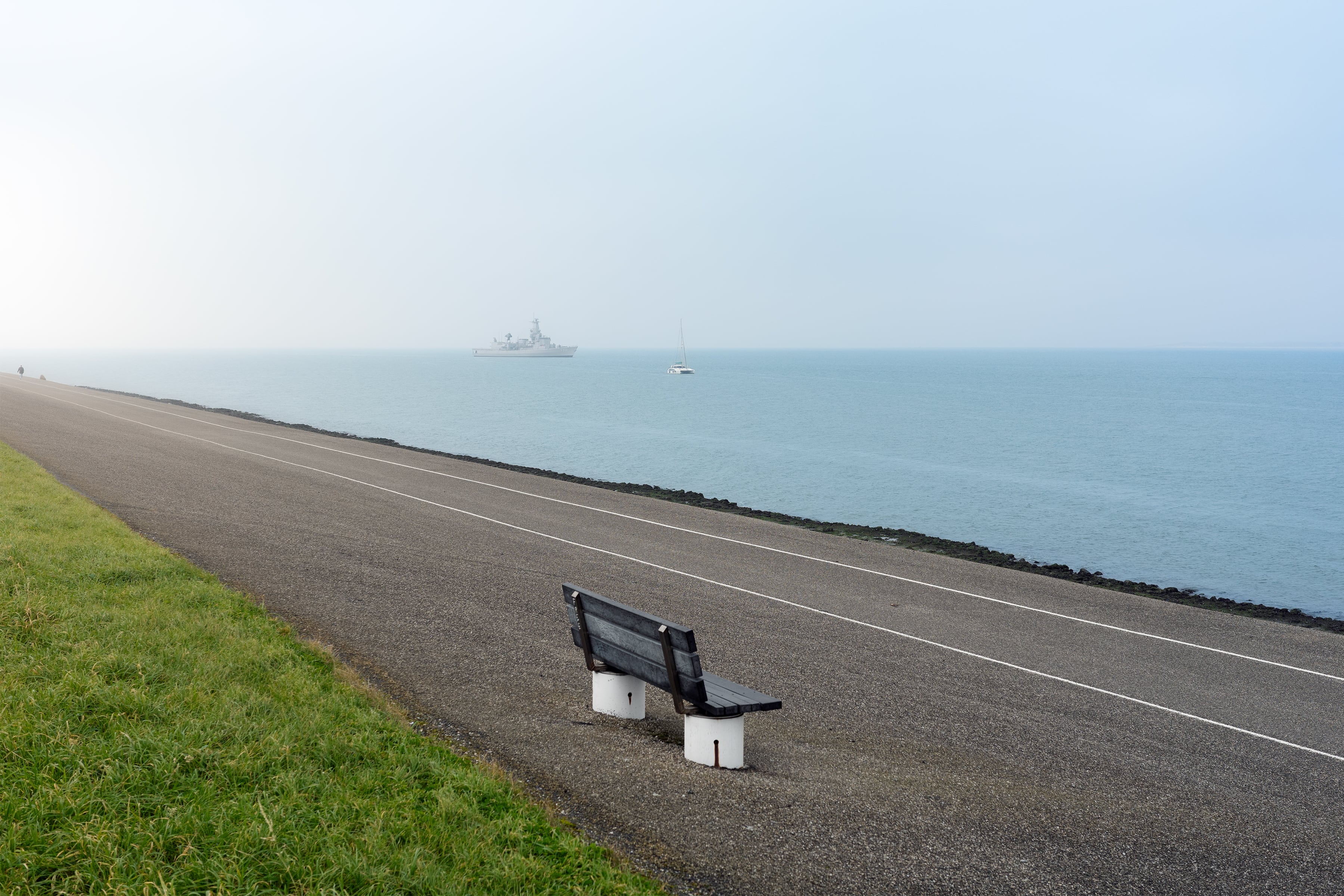
At a street stand, we bought “oliebollen,” the deep-fried dough balls the Dutch only sell in the cold months, and ate them walking from the town centre to the massive dike. From its top, the sea was almost waveless. I pointed at a thin yellow line on the horizon: “That’s Texel.”
“Really?” Max squinted. “I thought an island would look, hmm, taller…”
“Give it time. You’ll learn how flat this country is.”


Then I pointed at a pair of ferries crossing to and from the island. They run so often that one is almost always in sight. However, they weren’t alone at sea that day: a stranger vessel was out there with them, with the outline of a warship, and when it came closer I could read the number on its hull — F930.


The ship didn’t surprise me much, since Den Helder is the main base of the Dutch navy. But when I looked the number up, it was Belgian, the frigate “Leopold I.” The Dutch had built it and sailed it as the “Karel Doorman” before selling it to Belgium. It circled the same stretch of water for as long as we walked, and we decided it was on exercise, keeping an eye on us, the four suspicious Ukrainians, in the meantime.


We walked away from the town towards the “Lange Jaap” (“Tall Jake”), Europe’s tallest cast-iron lighthouse. On our summer trip, Oksanka and I had seen it bright red. Now, in the gloomy light, it was only a pale outline sticking up out of the flatness. The sun hung directly above it, a white disc behind the clouds.
“The lighthouse is made from 1,088 iron plates,” I told Max and Vika, and they started looking for the seams. “And guess how many bolts and nuts? Over twenty-one thousand.” They nodded the way you nod at a guide who has read too many Wikipedia pages.

We had lunch in Huisduinen, the village at Den Helder’s western edge, checking the rain forecast between spoonfuls of soup. Dutch weather can turn within an hour, and none of us wanted to get wet. The cloud moved on without a drop. Then, instead of following the dike down the coast, we turned inland into the dunes and groves, to Fort Kijkduin, built on Napoleon’s orders. He reportedly wanted Den Helder to become “the Gibraltar of the North” and came to inspect it in 1811.


We went into the fort’s latrine and looked out through the slits in its brick walls. Even the soldiers on the toilet could keep watch. From the roof, the view opened in every direction, as far as the sea behind the dike. Two hundred years ago, the frigate we’d watched from the dike would have sailed straight into its line of fire.

When the sun disappeared completely behind the clouds, we headed back through a dune grove and found a small lake with a tiny island in the middle. The trees around it were yellow, reddish and several shades of pale green. The water didn’t move at all. Upside down, I couldn’t have told the sky from the lake.


We walked the last stretch to the station in the dark, fast, ahead of the cold.
Back home in Scheveningen, Oksanka and I paid a visit to our local cast-iron lighthouse, a shorter brother of Den Helder’s, by the same engineer. Most of the beach pavilions were taken down for winter, and the beach stood empty until spring. Until then, Scheveningen belongs to the locals.


Leave a Reply